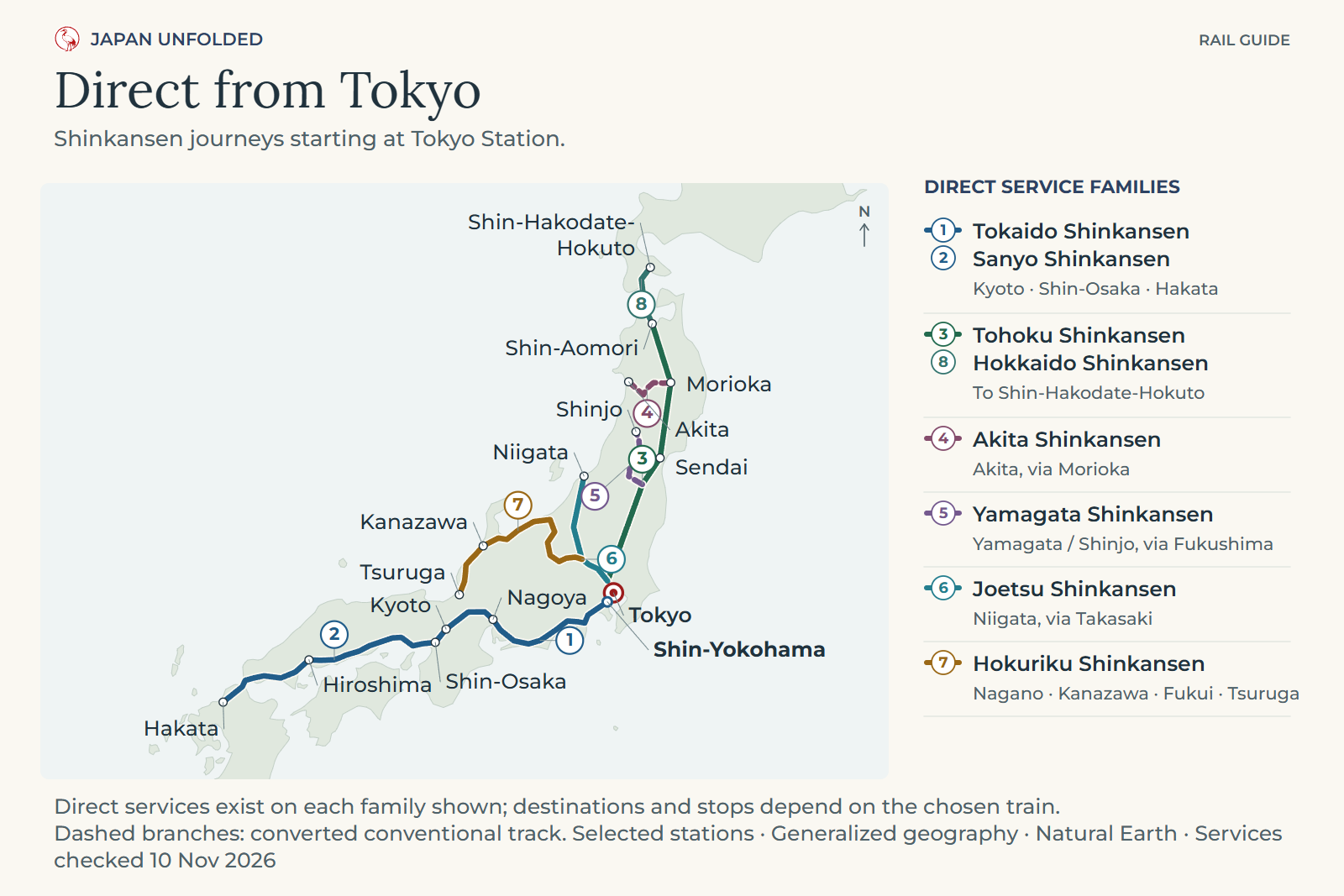
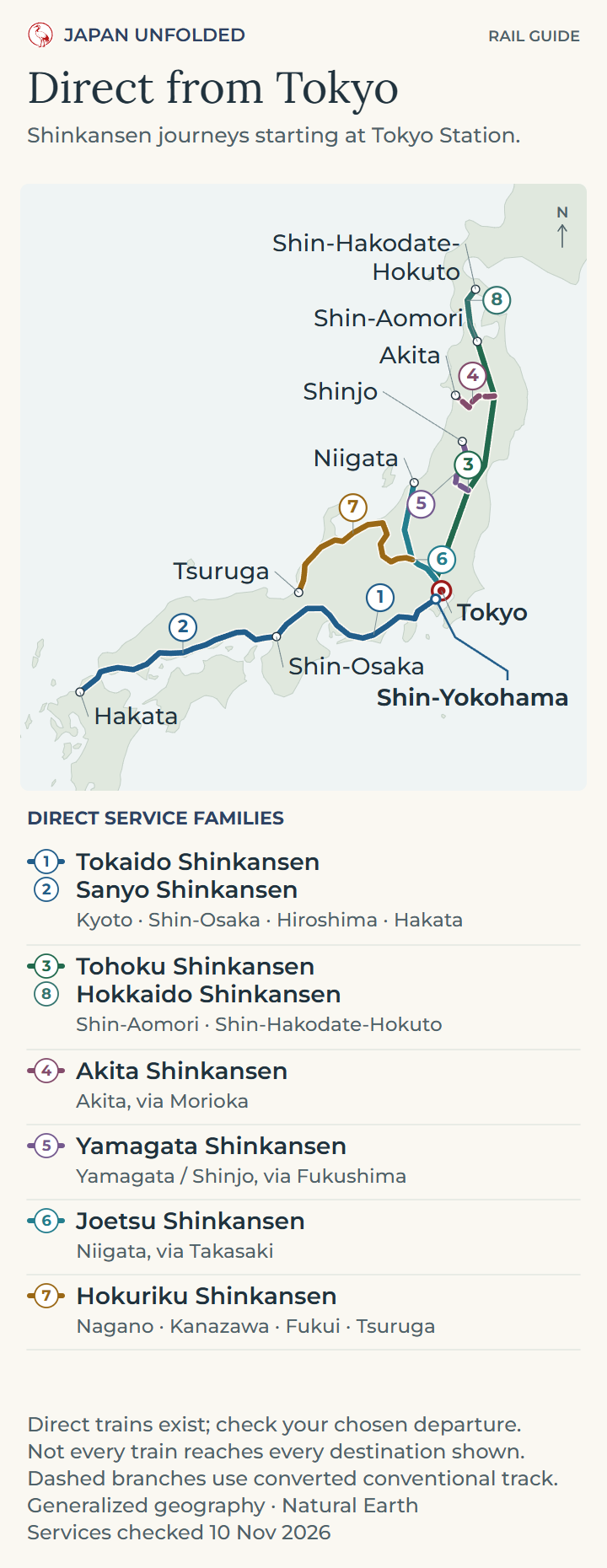
Tokyo Station and Shin-Yokohama can both be useful for a westbound Tokaido Shinkansen journey. The better choice depends on where you are staying and how you will reach the platform, rather than on the city name attached to the station. For a northern journey, the question changes because Shin-Yokohama is not a departure station for the Tohoku, Joetsu or Hokuriku Shinkansen.
Compare tickets and passes for Tokyo Station to Kyoto. Start with this one-way ride and add the rest of your itinerary.
Start by separating the long-distance destination from the local trip to board the train. A Kyoto journey may offer a genuine choice of Tokaido boarding stations, while a Kanazawa journey requires access to the Hokuriku corridor. Only after identifying the correct corridor is it useful to compare the routes from your hotel.
First decide whether you are going west or north
Nagoya, Kyoto or Shin-Osaka
How to think about the departure: Compare the complete trip via Tokyo and Shin-Yokohama, and include Shinagawa when relevant
What to avoid: Choosing a station before checking the hotel connection
A smaller Tokaido stop such as Odawara
How to think about the departure: Choose a boarding station and a train that actually stops at the destination
What to avoid: Assuming every westbound train serves every station
Nagano, Kanazawa or another Hokuriku destination
How to think about the departure: Reach an appropriate Hokuriku Shinkansen boarding station; Tokyo is one option
What to avoid: Treating Shin-Yokohama's Tokaido platforms as a northern departure
A journey beginning in central Yokohama
How to think about the departure: Include the local journey to Shin-Yokohama or another suitable boarding station
What to avoid: Using Yokohama and Shin-Yokohama as the same station name
Tokyo Station has different Shinkansen gate areas for the Tokaido/Sanyo side and the JR East northern and branch corridors. Follow the line or service name as well as the word Shinkansen. The Tokyo Station City maps are useful for relating the correct gate area to your arrival route.
If a journey from Shin-Yokohama goes east to Tokyo and then north, that is a connection between trains. A route map can show the onward network without implying through-running from the first train. Compare that itinerary with reaching the northern corridor on local rail before deciding how to travel from the hotel.
For Kyoto or Osaka, compare from the hotel door
Run the same dated journey twice, once through Tokyo Station and once through Shin-Yokohama. Include the walk from the accommodation, local train changes and the time between arriving at the station and boarding the Shinkansen. A comparison limited to the Shinkansen segment leaves out the part most likely to make one station easier for your group.
A hotel near Tokyo Station can make Tokyo the straightforward starting point. A base with a useful connection to Shin-Yokohama may make that station worth comparing instead. Neither is a universal rule for all of Tokyo or Yokohama, and a district name alone is too broad to settle the choice.
Shinagawa also deserves a comparison when the local journey naturally reaches it. You do not need to travel to Tokyo Station simply because the itinerary says you are leaving Tokyo. Check the complete fare and ticket arrangement for the station you intend to use, particularly if you have already bought a specific departure.
For a stop along the westbound route, use the Odawara Station guide to plan the local connection, or the Atami one-day itinerary to plan the visit beyond the station.
Shin-Yokohama is separate from Yokohama Station
If your hotel address says Yokohama, locate it on a map before selecting Shin-Yokohama as the departure. The city has several station areas, and Yokohama Station is a different place from the Shinkansen station. The local connection and the final approach to the Shinkansen gates remain part of the journey.
The Tokyu Shin-Yokohama Line provides another rail approach to Shin-Yokohama, with the operator listing Hiyoshi, Shin-tsunashima and Shin-Yokohama on the line. Use the official line and station information alongside a dated route search. Check the actual train destination and changes rather than assuming every departure on a connected line goes to Shin-Yokohama.
When comparing local approaches, count changes that require leaving one train and finding another platform. Also look at the walk between the arriving railway and the Shinkansen area. A route with fewer changes can be attractive with luggage even if another result has a slightly shorter advertised journey time.
At Tokyo Station, identify the correct gate area
Before arriving, note the long-distance train name and the railway corridor it uses. A Nozomi to Kyoto and a Hokuriku train towards Kanazawa do not leave from one common Shinkansen platform group. Check the station map from the side or local line you will actually use, rather than memorising a route from an unrelated entrance.
For a meeting with other travellers, agree a precise landmark or gate outside the paid area that everyone can reach. A vague instruction to meet at Tokyo Station can leave people on different levels or sides of the building. Keep the meeting separate from the train’s boarding time so that finding one another does not consume the transfer allowance.
If you need lifts, assistance or a ticket collection stop, build those into the approach. The shortest walking path on a map may not be the route you will use with a suitcase or wheelchair. Current station information is more useful for that decision than a fixed promise that every transfer takes the same number of minutes.
Book the station you plan to use
When you settle on the boarding station, read it back on the booking before confirming. Tokyo, Shinagawa and Shin-Yokohama are separate choices, even when the same westbound service calls at them. If plans change later, check the ticket’s alteration and boarding conditions before assuming that a different station can be used without any action.
The JR Central timetable page helps identify the Tokaido corridor, while the actual booking result should govern the departure you buy. Check the destination, train number, class and seat details as well as the boarding station. For an intermediate stop, open the stopping pattern before treating the train as suitable.
Check Tokyo Shinkansen tickets
Explore Tokyo–Kyoto and Tokyo–Shin-Osaka tickets with Japan Experience.
These links start at Tokyo Station. Check the exact boarding station, destination and ticket conditions before booking.
Make the arrival as precise as the departure
Carry the same station-level thinking to the other end of the trip. A Kyoto arrival and a Shin-Osaka arrival lead to different local journeys, and Shin-Osaka is separate from Osaka Station. Add the hotel connection before deciding whether a train arrives early enough for the rest of the day.
Once both ends are clear, choose the boarding station that gives your group the most workable complete journey. Save the route from the hotel and the confirmed train details together. That leaves you with one specific plan to follow on departure morning, rather than several station names that looked interchangeable during booking.