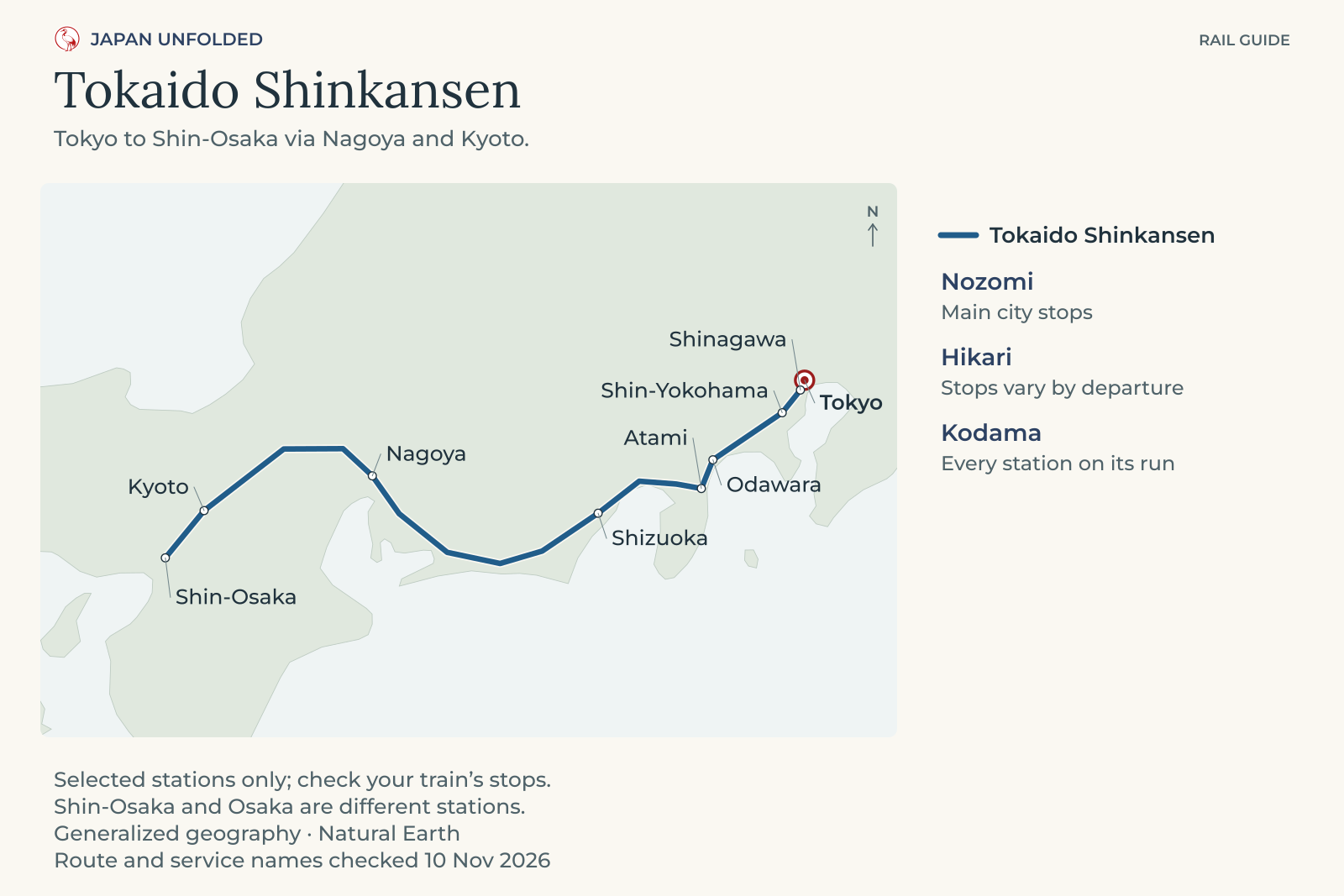
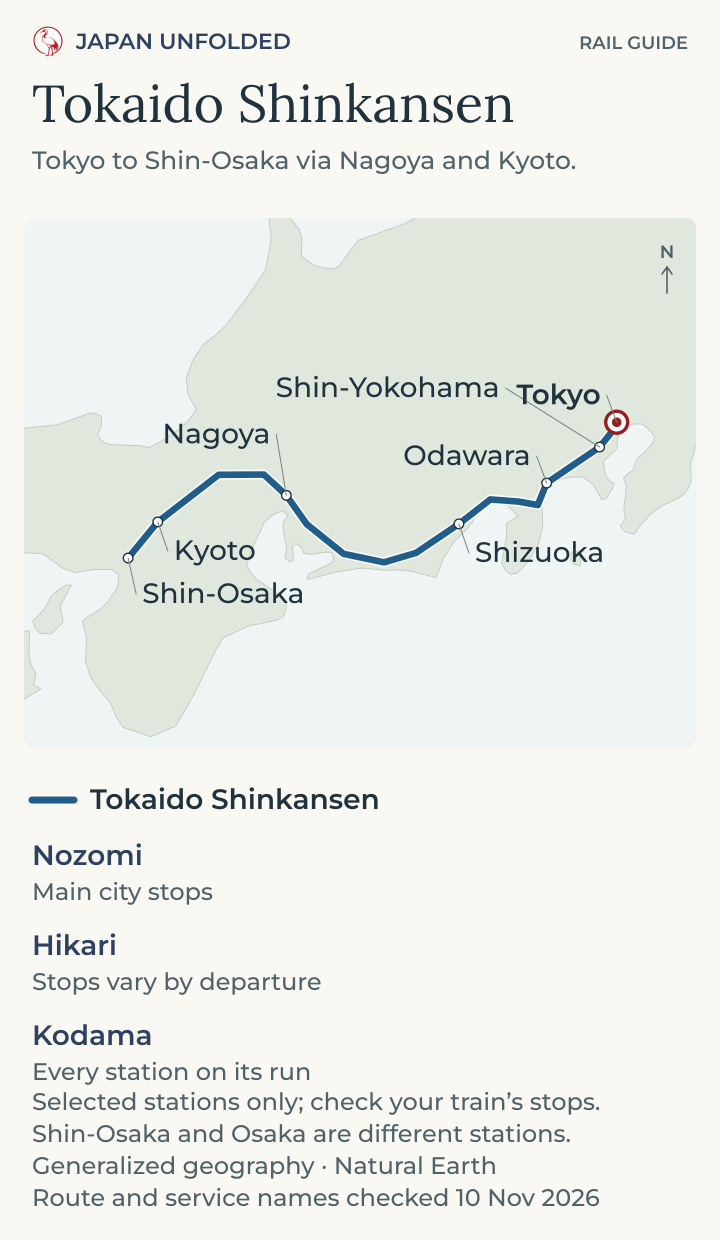
For a straightforward journey between Tokyo and Kyoto, Nozomi is a useful starting point when comparing trains. For Odawara, Shizuoka or another intermediate stop, the first question changes: which departure actually serves that station? Nozomi, Hikari and Kodama share the Tokaido Shinkansen corridor, but their different stopping patterns make them useful for different journeys.
Compare tickets and passes for Tokyo to Shin-Osaka. Start with this one-way ride and add the rest of your itinerary.
Choose the station pair before choosing the train name. Kyoto is a Shinkansen station, while the Osaka-area stop is Shin-Osaka rather than Osaka Station. On the Tokyo side, Tokyo, Shinagawa and Shin-Yokohama are different places to board, so the trip from your hotel belongs in the comparison too.
The three train names solve different problems
Nozomi
A useful starting point for: Long journeys between the main Tokaido city stations
What to check: Your ticket or pass permits the service, and the actual train serves your endpoint
Hikari
A useful starting point for: A main-city trip or an intermediate station served by a particular departure
What to check: The individual stopping pattern; the name alone is insufficient
Kodama
A useful starting point for: An intermediate Tokaido station or a journey where a simpler stopping service suits you
What to check: The train's final destination, journey duration and any proposed change
Kodama serves every station along the part of the Tokaido route that it runs. Hikari skips stations, with the selection changing between departures. Nozomi concentrates on the main stops, so a faster-looking result is useful only if it takes you to the place you need.
That distinction matters most when the destination is outside the Tokyo–Nagoya–Kyoto–Shin-Osaka main-city chain. A gateway can be important to a visitor without being a Nozomi stop. Search for the actual station rather than assuming that a prominent name on a route map is served by every train.
For Tokyo, Nagoya, Kyoto and Shin-Osaka
If both ends of the journey are main-city stations, begin by comparing a direct Nozomi with the other departures available at a sensible time. Keep the comparison tied to the same date, travel class and arrival station. A small difference in the train journey may matter less than an awkward departure from the hotel or an inconvenient arrival at your next base.
Hikari can still be the better fit when it matches the ticket you plan to use or leaves at a more convenient time. Look at the complete result rather than treating the service names as a ranking of good and bad trains. For a reserved journey, the departure you can actually book matters more than the fastest service shown in a general description.
At the Osaka end, carry the journey through Shin-Osaka to the hotel or sightseeing area. Arriving at Shin-Osaka does not mean you have reached Osaka Station, Umeda or Namba. Compare that final connection before deciding whether the arrival time works for check-in, dinner or another reservation.
For Odawara, Atami and the smaller Tokaido stops
Odawara is a useful example because Nozomi does not stop there. Look for a Hikari that specifically includes Odawara, or a suitable Kodama, rather than booking the first train travelling in the right direction. The same habit is useful for other intermediate stations: open the stopping details before paying.
A route search may offer a fast train followed by a change to a stopping train. Compare that with a direct service at a slightly different departure time, particularly when carrying luggage or travelling with children. A connection can be worthwhile, but an extra train is a practical cost even when the search result shows an earlier arrival.
A station name also needs to match the destination beyond the railway. Odawara, Mishima and Shin-Fuji are separate gateways, and none should be selected simply because the trip is described as going to Fuji or Hakone. For a Hakone journey through Odawara, the Odawara Station guide explains how the station relates to the town and onward travel.
If you are stopping in Odawara, the shopping streets guide follows the area between the station and castle. The Atami one-day itinerary offers another stop along the Tokaido corridor, while the Hakone Shrine guide helps plan an onward visit beyond the Shinkansen gateway.
A rail pass can change the comparison
If you are using the national Japan Rail Pass, do not assume that it covers a Nozomi journey in the same way as Hikari or Kodama. Nozomi use requires the additional, specially issued ticket specified by the operators. Read the official Japan Rail Pass special-ticket guidance before deciding whether that combination or an eligible alternative suits the trip.
Other passes and discounted tickets have their own rules, so the national pass rule is not a general rule for every rail product. Check the named product, the route and any service restriction against your chosen departure. A ticket that fits one leg of the itinerary may be a poor reason to rearrange the rest of the day.
Reserve for the journey you intend to make
During designated major peak periods, Nozomi operates with all seats reserved on the Tokaido and Sanyo Shinkansen. Check the current dates in the official Nozomi peak-period guidance before relying on a non-reserved plan. If the departure matters to a flight, hotel arrival or onward reservation, settle the seat and ticket arrangements while there are still useful alternatives.
Before confirming, read back the departure station, arrival station, train name and number, date and seat choice. If a route includes a change, check that both trains are included in the booking you expect to make. Also use the operator’s current luggage guidance for the bags you will carry, rather than assuming that a seat reservation automatically settles luggage arrangements.
Book your Tokaido journey
Explore Tokyo–Kyoto and Tokyo–Shin-Osaka tickets with Japan Experience.
These links start at Tokyo Station. If you are departing from the Tokyo area, compare boarding at Tokyo Station or Shin-Yokohama. Check the exact boarding station, destination and ticket conditions before booking.
Check the actual train, then the whole journey
Use the JR Central timetable page to understand the corridor, then use a dated journey or booking search for the trip itself. The published basic timetable is not a promise that every extra or seasonal train is included. Keep the confirmed train details where you can find them at the station, especially if several services leave close together.
For the day of travel, leave enough room to reach the correct Shinkansen gates and find the platform without turning the transfer into a race. Match the departure board to your train number and destination, then use the car and seat information on your reservation. The useful choice is the train that serves the right station and fits the rest of your day, with a ticket you understand.