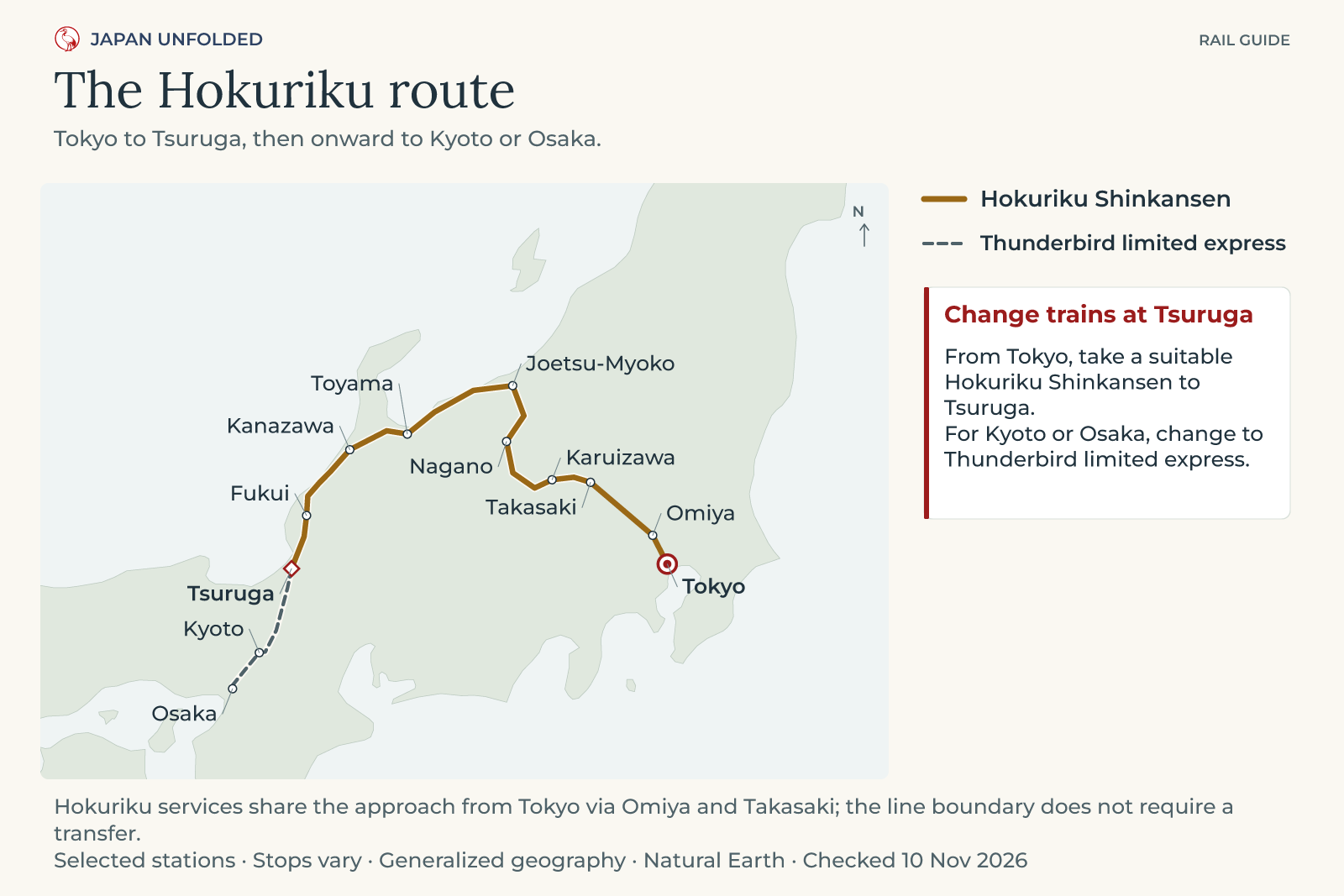
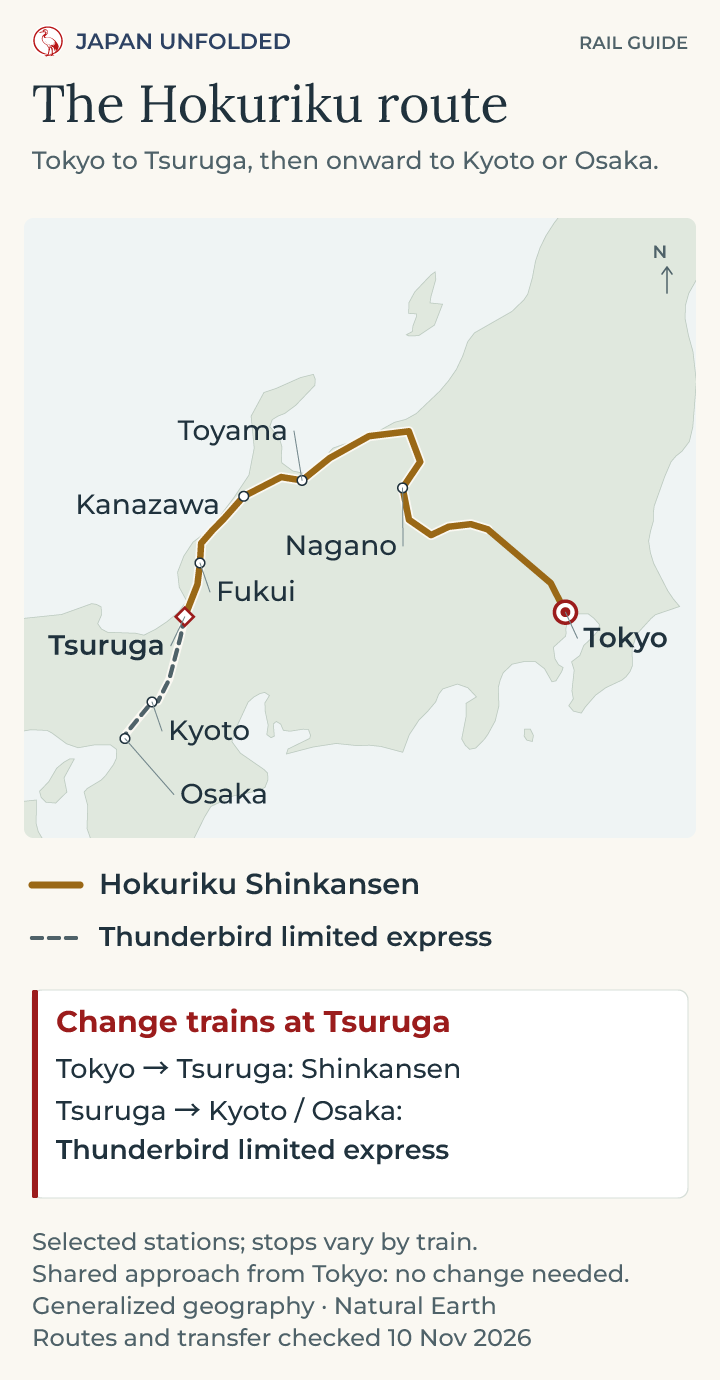
From Tokyo, you can ride a Hokuriku Shinkansen straight to Kanazawa. From Kanazawa to Kyoto or Osaka, take the Shinkansen to Tsuruga, then change to the Thunderbird limited express. Travelling in the opposite direction, board Thunderbird first and change at Tsuruga for Kanazawa.
Compare tickets and passes for Tokyo → Kanazawa → Kyoto. The calculator starts with Tokyo to Kanazawa on day 1 and Kanazawa to Kyoto on day 3. Remove or add rides to match your plans.
Which side are you approaching from?
Tokyo towards Nagano, Toyama, Kanazawa or Fukui
Route: A suitable Hokuriku Shinkansen departure
Keep in mind: The train must stop at, and continue as far as, your destination
Kyoto or Osaka towards Kanazawa, Toyama or Fukui
Route: Thunderbird to Tsuruga, then Hokuriku Shinkansen
Keep in mind: Tsuruga is a train change, not a through Shinkansen ride from Osaka
Nagoya or Maibara towards Hokuriku
Route: A suitable Shirasagi and Shinkansen connection via Tsuruga
Keep in mind: Check the actual Shirasagi origin and whether an earlier change is needed
Tsuruga itself
Route: The service that reaches Tsuruga from your starting point
Keep in mind: An onward change is needed only if you are continuing beyond it
A route map showing Tokyo, Nagano, Kanazawa and Tsuruga is a picture of the corridor, rather than one train’s stopping pattern. Different departures stop at different stations and can finish before the end of the line. Search for the city station you need instead of selecting a train solely because its name belongs to Hokuriku.
On the Tokyo-facing side, Kagayaki is an all-reserved service, while other service families have different seating arrangements. The JR East Hokuriku Shinkansen guide is a useful starting point for the train families. Make the final choice against the departure and seating options offered for your travel date.
What the Tsuruga change means in practice
For a Kyoto or Osaka connection, treat the Shinkansen and Thunderbird as two trains even when they form one itinerary. You need to leave the arriving train, follow the transfer route and board the connecting departure. A continuous line in a route search, or a ticket covering the whole journey, does not remove that physical change.
JR West provides a Tsuruga transfer guide with the station layout and ticket-gate instructions. Look at the direction relevant to your journey before travel, because arriving from Osaka and arriving from Kanazawa reverse the sequence. Keep the connecting train’s departure time, destination, car and seat details available before leaving the first train.
Follow the transfer signs towards the train you need rather than heading automatically for a town exit. If you have chosen a longer interval for a break, check the conditions of your ticket before passing through an exit gate. For a straightforward connection, remaining focused on the onward service avoids turning the station change into an unplanned detour.
Choose a connection you can use comfortably
A journey search may present a compact connection because the trains are arranged to connect. That does not tell you whether the interval suits your group, mobility needs or luggage. If changing trains is unfamiliar, compare the next available connection before committing to the shortest result.
Travellers needing a step-free route should check the operator’s station information and arrange any required assistance in advance. Keep that need visible while choosing the itinerary, rather than assessing it only after the tickets are bought. A connection that looks simple on a network map may involve levels, gates and a different platform.
If your first train is delayed, use the operator’s current information and ask staff about the booked onward journey. Do not assume that you can board any later reserved train on unchanged terms. The appropriate next step depends on the ticket, the disruption and the connection, so keep both parts of the itinerary together when asking for help.
The transfer gate depends on your ticket
At the transfer gate, feed your paper tickets in together. If you have four or more, show them to staff. With an eligible IC-only ticket, tap your card or phone. If your journey uses both paper and IC, insert the tickets first, then tap. Take any ticket issued on board to the staffed gate.
Before leaving the first train, gather the travel documents for both legs and keep them separate from receipts or unrelated tickets. If the booking requires collection, complete that step before relying on it as a boarding document. When the gate or ticket combination is unclear, show the itinerary to staff before repeatedly trying different cards and papers.
Hokuriku can be part of a longer itinerary
The corridor can link a Tokyo stay with time in Hokuriku and an onward Kyoto or Osaka stay. Plan the stop you want in its own right, including the arrival station, accommodation and local travel. The railway makes the sequence possible, but it does not turn every city along the route into a convenient short stop.
If the sole purpose is to travel from Tokyo to Kyoto, compare the Hokuriku itinerary with the Tokaido route before booking. Going via Hokuriku adds a different geography and a change at Tsuruga, which may make sense when that region is part of the trip. Choose it for the places you intend to visit, rather than assuming that every rail line between two familiar cities is interchangeable.
Before confirming both trains
Use JR West’s route and ticket search for the western connection and read the complete result. Confirm the date, direction, departure stations and Tsuruga connection, then check the seat and collection arrangements for each leg. A pass, if you are using one, also needs to match both services and the specific route.
On the travel day, check current operating information before starting and again if the journey changes. Keep the onward train details easy to reach, especially if the first train ends at Tsuruga. Once the connection is understood as a normal change between two booked trains, the rest of the planning becomes a question of choosing a comfortable departure and arrival.